We rebuilt the platform we had been using inside Altagram, and opened three of the tools we built there to everyone.
14 days, every tool open, no credit card. Already have a login? It still works.
Nothing you had has moved
Your login still works.
Projects, translation memories and termbases came across automatically, so there is nothing to reconstruct and no old project to go hunting for.
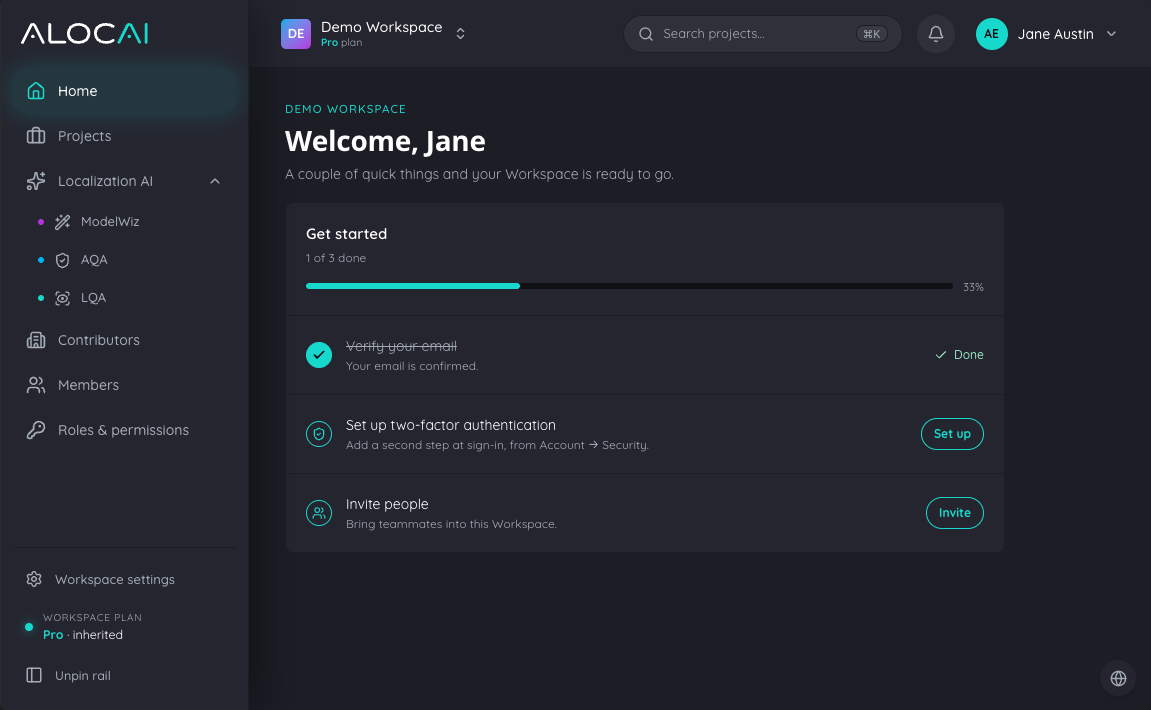
The new tools live inside your workspace. If you do not have one yet, create it and they are there.
Fair warning: parts of our website and FAQ still describe the old platform. We are shipping faster than we are documenting. If something looks wrong, tell us. You will get one of us, not a ticket number.
New. Audio QA
Your subtitles say one thing. The voice says another.
Here is where this came from.
We had a title in 12 languages, 76,000 lines in each. Our team refused to deliver it unchecked, and they were right.
Doing it properly meant a native speaker with headphones on, the right software open, the script beside them, listening to every file and writing corrections as they went. A minute or two per line.
One language alone is more than 1,250 hours of listening. Across all 12, more than 15,000 hours, and that is the fast end of the estimate. Roughly eight person-years of somebody sitting and listening.
We did not have the hours, and we could not put that cost in front of anyone.
The usual shortcut is to spot check the start and the end. It feels sensible. It also misses the thing that actually went wrong in the middle.
Lines do change in the voice-over booth. Not often. The audio director normally catches the change and logs it. But sessions run long, schedules get tight, and once in a while the change does not make it back into the script. Sometimes a typo or grammar mistake gets written in alongside it.
The recording is good. The script is now wrong.
Players really hate that.
So you add another pass. Someone checks the subtitles against the audio, finds the handful of things that changed, and spends the rest of the time confirming what was already fine.
Audio QA is that pass.
Upload the script and the audio. Every take is transcribed and matched to its line. The mismatches come back with the exact second they happen: silent files, wrong takes, words that changed in the booth, errors that made it into the as-rec script.
And then there is the useful bit.
Alongside the report, you get a clean As Rec script built from what was actually said. Your subtitles and your audio can finally agree without somebody having to run another reconciliation pass by hand.
A whole batch runs in one go, multilingual. Each report can then go to a native speaker to confirm the finding, accept the change, or call for a re-record.
New. Vision, linguistic QA on screens
The check everyone skips
A mobile title ships a small update across 30 languages.
There are a handful of things to check in each one. The check itself is short. Arranging testers in 30 languages takes considerably longer, and someone still has to play through the build to capture the screens.
So on small updates, the testing often does not happen.
Not because anyone is cutting corners. The check is real work. The problem is that a very small amount of checking can require a surprisingly large amount of arranging.
There is another part of the job. A lot of review time goes into order verification, truncation, typos and grammar. Those bugs matter. They need finding. But they are also exactly the sort of thing a machine can look for without asking a reviewer to spend their attention there.
Vision goes first.
Give it localized screenshots, or a gameplay capture, and it proposes the frames worth reviewing. Per screen it checks truncation, overflow, missing translations, typos, terminology and tone, with a severity and a suggested fix. It checks against your glossary and style guide.
Developer issues and linguistic issues come back separately, so they can reach the right person. A Jira connection is coming.
Your team reads the report before anything is exported or sent on. Always.
Then the next build gets reviewed by people who can spend their time on the things that actually need them.
What Vision does not do
We would rather tell you the ceiling than let you discover it yourself.
Typos, spelling and missing translations: around 85 percent. Grammar, inconsistent fonts and truncation: around 60 percent.
Cultural and contextual judgment stays with human reviewers. So does idiomatic judgment. Whether something works for that character. Whether a gendered form is right for who is speaking. Whether it fits the culture and context of the scene.
Those are not machine decisions we are pretending to have solved.
And capturing the screens still takes time. Someone has to play through the build. It is less work than a full LQA pass, but it is not nothing.
ModelWiz, our game-trained translation engine
Built for games
A general translation model sees a game as text.
That is the problem.
Placeholders break. Terminology drifts. Register changes between builds. The sentence can be perfectly understandable and still be wrong for the game.
ModelWiz was trained on game content specifically, not the open web.
The linguists who compare engines tend to come back with the same three reasons for preferring it over DeepL and general-purpose models: accuracy, terminology, and less to fix during review. We have the comparison analyses. Ask us and we will send them.
Then you can make it specific to your game.
Customization starts with a set of questions per language. From there, ModelWiz learns from reviewer feedback, so the same mistake stops recurring and your variables, placeholders and house exceptions are followed exactly.
A customized model is only as good as the expertise behind it. We think that part should stay visible.
You can paste your own dialogue, UI or store text into the web app and compare it with whatever you use today. Two minutes is enough to have an opinion.
Chat and Q&A have grown up
This is the part many of you already use.
Per-language rooms. A general channel. Terminology threads. Testers in the room alongside linguists. The PM can see where a question is stuck.
Queries, files and answers stay attached to the project instead of disappearing into somebody's inbox.
It is faster now, and the conversations are connected to the work happening around them.
And it keeps moving
Workflows that run across the tools. Audio QA findings written into Jira. More from Vision. More languages. Better file management. More on security and user management.
Some of it ships within days.
Tell us what you would find useful. We do read those.
14 days, every tool open, on your own content
Create your workspace and everything above is open for 14 days. No credit card.
Use your own scripts, your own screens, your own text. That is the quickest way to find out whether it is useful to you.
Plans start at EUR 29 a month. See the plans.
You will get one of us, not a ticket number
help@alocai.com for something that is not working.
hello@alocai.com for plans, pricing, commercial questions or anything about your projects.